What Are GH and KH?
GH is general hardness (calcium and magnesium); KH is carbonate hardness that buffers pH. Learn the difference, the ppm conversion, and ideal ranges.
GH (general hardness) measures the calcium and magnesium dissolved in your water, while KH (carbonate hardness) measures the carbonates that buffer your pH and keep it stable. They sound alike, but they do different jobs, and testing both is one of the most overlooked habits that separates a stable tank from one that crashes.
Most beginners obsess over pH and never test hardness, then wonder why their pH swings or their shrimp will not molt. The answer usually lives in GH and KH. For a deeper walkthrough, see our full guide on GH and KH explained.
Test Your Hardness
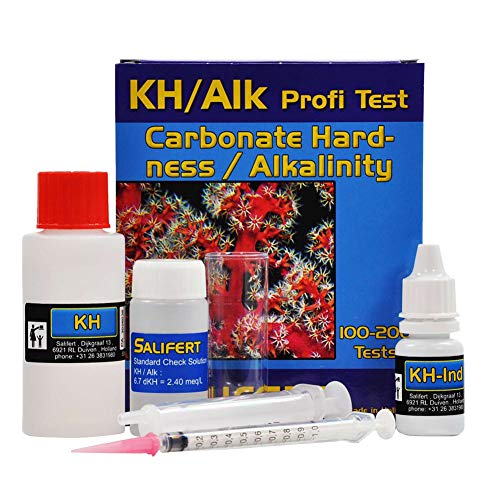
Salifert Carbonate Hardness (KH) Test Kit
Liquid titration kit reads carbonate hardness drop by drop for accurate numbers.

Quick strips for routine GH, KH, pH, nitrite, and nitrate checks between liquid tests.
What GH measures
GH, general hardness, is the total dissolved calcium and magnesium in your water. These minerals are essential. Fish use them for osmoregulation and bone health, shrimp and snails need calcium to build and molt their shells, and plants draw on magnesium for photosynthesis. Water with very low GH is missing nutrients your livestock depends on, which is why pure RO water is never used straight from the filter.
What KH measures and why it buffers pH
KH, carbonate hardness, measures the carbonates and bicarbonates in your water. Think of KH as your pH shock absorber. Acids constantly form in an aquarium from fish waste, the nitrogen cycle, CO2, and driftwood. KH neutralizes those acids before they can lower your pH. As long as KH holds, pH stays steady.
When KH runs out, the buffer is gone and pH can crash fast and hard. This is the single most important reason to test KH, because a sudden pH crash is almost always a depleted KH problem in disguise.
Units and the ppm conversion
Hardness is reported either in degrees (dGH or dKH) or in parts per million (ppm). The two are easy to convert once you know the ratio: one degree equals about 17.9 ppm. So if a kit reads 5 dKH, that is roughly 90 ppm, and a report listing 120 ppm GH is about 6.7 dGH.
| Degrees (dH) | Approx. ppm | Classification |
|---|---|---|
| 0 - 3 | 0 - 50 | Very soft |
| 4 - 6 | 70 - 110 | Soft |
| 7 - 12 | 125 - 215 | Medium / moderately hard |
| 13 - 18 | 230 - 320 | Hard |
| 19+ | 340+ | Very hard |
To switch between dH, ppm, and other units quickly, use our aquarium unit converter.
Ideal GH and KH ranges
Target ranges depend on your fish, but a few practical defaults cover most freshwater tanks.
- General community tank: GH 4 to 12 dGH, KH 4 to 8 dKH.
- Soft-water species (discus, wild bettas, many tetras): lower GH, but keep KH at 3 dKH or more for stability.
- Hard-water species (livebearers, African cichlids, goldfish): higher GH and KH.
- Shrimp: species-specific, so check the needs of your particular shrimp.
The most important rule is to keep KH at roughly 3 to 4 dKH or above so your pH cannot crash, a point we cover further in our pH guide.
How to adjust GH and KH
Raising hardness
- Crushed coral or aragonite in the filter dissolves slowly and raises both GH and KH.
- Baking soda raises KH directly; add small amounts and retest.
- A GH remineralizer with calcium and magnesium is the go-to when starting from RO water.
Lowering hardness
The cleanest way to soften water is to mix in RO, RODI, or distilled water, which dilutes the minerals to a target ratio. Peat moss and catappa leaves lower hardness modestly while tinting the water. Resist chasing very soft water unless a specific species demands it, because stripping out KH removes your pH buffer.
How hardness ties into everything else
GH and KH do not work alone. KH supports pH, pH affects ammonia toxicity in the nitrogen cycle, and steady hardness keeps the whole tank predictable. If you inject CO2 in a planted tank, KH and pH together reveal your dissolved CO2 level, which you can dial in with our CO2 calculator. Explore more chemistry topics on the Water and Care hub.
Aquarium Setup & Maintenance Planner
Stocking planner, water-test log, cycling tracker, maintenance schedule, and more, in one printable planner that keeps your tank on track.
Frequently Asked Questions
What is the difference between GH and KH?
GH, general hardness, measures dissolved calcium and magnesium, the minerals fish, shrimp, and plants need for healthy bodies and shells. KH, carbonate hardness, measures carbonates and bicarbonates that buffer pH and keep it from swinging. GH affects livestock health, while KH protects pH stability. They are related but separate, so you should test both because each does a different job in your tank.
What does ppm mean for water hardness?
Ppm means parts per million, a common unit for hardness alongside degrees (dGH or dKH). One degree of hardness equals about 17.9 ppm, so 4 dGH is roughly 72 ppm. Test kits and reports may use either unit, which can be confusing. Knowing the conversion lets you compare your readings to recommended ranges regardless of how a source labels them.
What are good GH and KH levels?
For a general community tank, aim for GH around 4 to 12 dGH and KH around 4 to 8 dKH. Soft-water fish like discus prefer lower values, while livebearers and African cichlids want harder water. The most important target is keeping KH at 3 to 4 dKH or above, because that protects pH from crashing between water changes. Match your fish to your tap water when you can.
Does low KH cause pH to crash?
Yes, low KH is the leading cause of pH crashes. Acids from fish waste, the nitrogen cycle, CO2, and driftwood constantly form and consume KH over time. Once KH falls near zero, there is nothing to absorb those acids, and pH can plummet within hours, harming fish and stalling beneficial bacteria. Testing KH regularly and topping it up prevents this. A pH crash is usually a KH problem in disguise.
How do I raise or lower GH and KH?
To raise KH, add crushed coral, aragonite, or baking soda, which add carbonates. To raise GH, use a remineralizer with calcium and magnesium, or crushed coral, which raises both. To lower either, mix in RO, RODI, or distilled water to dilute the minerals. Always adjust slowly and retest, because large fast changes stress fish more than slightly imperfect numbers.
Planning or running a tank?
Use our free calculators and guides to get every number right.
Aquarium Planner: $39