Aquarium Temperature Chart by Fish
Ideal aquarium temperature ranges in Fahrenheit and Celsius for 20 popular freshwater fish, from betta and neon tetra to goldfish, discus, and angelfish.
Water temperature drives almost everything in a fish tank: metabolism, appetite, immune strength, oxygen levels, and how active your fish behave. Each species evolved for a particular band, and keeping them inside it is one of the simplest ways to prevent disease and stress. The chart below lists ideal ranges for the most popular aquarium fish in both Fahrenheit and Celsius.
Quick answer: Most tropical community fish are happiest at 74 to 80 degrees Fahrenheit (23 to 27 Celsius). Bettas like 78 to 80 F, neon tetras 70 to 78 F, goldfish 65 to 72 F, discus 82 to 88 F, and angelfish 76 to 84 F. Stability beats chasing a perfect number. Size your heater at roughly 3 to 5 watts per gallon with our heater size calculator.
Aquarium temperature chart by species
Ranges below are the comfortable keeping band for healthy adults. Where a species spawns or recovers from illness it may want the warmer end. Celsius is rounded to the nearest half degree.
| Fish | Ideal temp (F) | Ideal temp (C) |
|---|---|---|
| Betta | 78 to 80 F | 25.5 to 26.5 C |
| Neon tetra | 70 to 78 F | 21 to 25.5 C |
| Cardinal tetra | 73 to 81 F | 23 to 27 C |
| Fancy goldfish | 65 to 72 F | 18 to 22 C |
| Common goldfish | 60 to 70 F | 15.5 to 21 C |
| Discus | 82 to 88 F | 28 to 31 C |
| Angelfish | 76 to 84 F | 24.5 to 29 C |
| Guppy | 72 to 82 F | 22 to 28 C |
| Molly | 72 to 78 F | 22 to 25.5 C |
| Platy | 70 to 78 F | 21 to 25.5 C |
| Swordtail | 72 to 79 F | 22 to 26 C |
| Corydoras catfish | 72 to 78 F | 22 to 25.5 C |
| Bristlenose pleco | 73 to 81 F | 23 to 27 C |
| Zebra danio | 64 to 77 F | 18 to 25 C |
| Cherry barb | 73 to 81 F | 23 to 27 C |
| Tiger barb | 74 to 79 F | 23.5 to 26 C |
| Dwarf gourami | 77 to 82 F | 25 to 28 C |
| German blue ram | 78 to 85 F | 25.5 to 29.5 C |
| Kuhli loach | 75 to 82 F | 24 to 28 C |
| White cloud minnow | 64 to 72 F | 18 to 22 C |
| Cherry shrimp | 65 to 78 F | 18 to 25.5 C |
| Mystery snail | 68 to 82 F | 20 to 28 C |
Why stability matters more than the exact number
Fish handle a steady temperature anywhere in their range far better than a tank that drifts up and down each day. Rapid swings suppress the immune system and are a leading trigger for ich outbreaks, which often appear after a cold snap or a heater failure. Aim to hold your chosen temperature within a degree or two around the clock rather than fixating on one precise figure.
Warmer water also holds less dissolved oxygen and speeds metabolism, so fish in a high-temperature tank like a discus setup eat more, waste more, and need stronger aeration and filtration. Cooler water is the reverse. This is one reason goldfish and tropical fish make poor tankmates: the temperature that suits one stresses the other, regardless of how peaceful they seem.
Reliable Aquarium Heaters

Fluval M 200-Watt Submersible Aquarium Heater
Precise heat for tanks up to about 65 gallons.
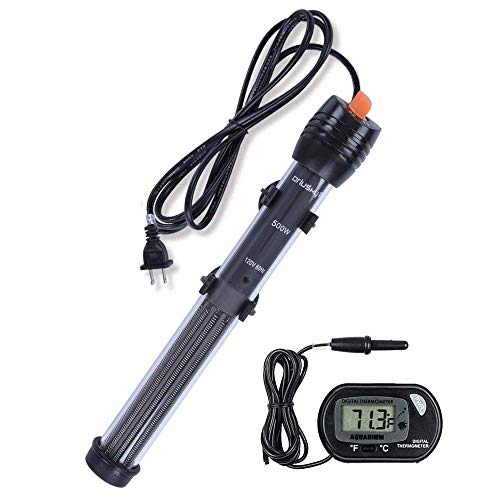
Orlushy Submersible Aquarium Heater with Thermometer
Adjustable heater with a free thermometer included.
Choosing and placing a heater
Pick a heater sized to your tank and your room. The common starting point is 3 to 5 watts per gallon, but a chilly basement needs more wattage to bridge a bigger gap between room and target temperature, while a warm living room needs less. Tanks of 50 gallons and up benefit from two smaller heaters: they spread heat evenly and, if one fails, the other limits the damage. Look up wattage for your tank on the heater size chart, or run your exact numbers through the heater size calculator.
Mount the heater near a flow source, such as the filter outlet or a powerhead, so warmed water circulates instead of pooling. Place a thermometer at the far end of the tank to confirm even heat and to catch a stuck heater early. Submersible heaters can lie horizontally low in the tank, which keeps the warmth where bottom dwellers live.
Cooling a tank in summer
Overheating is as dangerous as cold, especially for cooler-water species. If a heat wave pushes the tank past the safe band, raise the lid for evaporation, aim a small clip fan across the surface, dim or shorten the lights, and float a sealed bottle of ice water. A clip-on fan is the most effective low-cost fix because evaporative cooling can drop a tank several degrees. Always pair higher temperatures with extra surface agitation to protect oxygen levels.
Plan the rest of the build
Temperature is one piece of a healthy tank. Confirm your fish also share pH and hardness needs on the water parameters by species chart, check that they get along on the compatibility chart, and plan numbers with the stocking calculator. To convert any unit while you plan, the unit converter handles Fahrenheit, Celsius, gallons, and liters. Browse every table at our reference charts hub.
Frequently Asked Questions
What is the ideal temperature for a tropical fish tank?
Most tropical community fish thrive between 74 and 80 degrees Fahrenheit, roughly 23 to 27 Celsius. That band keeps bettas, tetras, guppies, corydoras, and gouramis comfortable in the same tank. Stability matters more than hitting an exact number, so set a reliable heater near the middle of your stock list and let it hold steady rather than chasing a perfect reading.
Do goldfish need a heater?
Fancy goldfish do best at 65 to 72 degrees Fahrenheit and common goldfish tolerate cooler water still, so in a heated indoor room they often need no heater at all. The bigger risk is keeping goldfish too warm in a tropical community tank, where the higher metabolism stresses them. If your room drops below the mid 60s in winter, a low set heater prevents chilling swings.
How do I raise or lower aquarium temperature safely?
Change temperature slowly, no more than 2 to 3 degrees per day, because fish handle gradual shifts far better than sudden ones. To warm a tank, nudge the heater up a degree or two and wait. To cool one in summer, float a frozen water bottle, add a clip fan over the surface, or reduce the lighting. Never pour hot or cold water directly into the tank.
What size heater do I need for my tank?
A common guideline is 3 to 5 watts per gallon, so a 20 gallon tank usually wants a 75 to 100 watt heater and a 55 gallon wants around 200 to 300 watts. Colder rooms and larger temperature gaps need the higher end, and big tanks often run two smaller heaters for safety and even heat. Get a precise figure from our heater size calculator before buying.
Can different fish with different temperatures live together?
Only if their ranges overlap. You can pair fish whose ideal bands share a comfortable middle, for example neon tetras at 70 to 78 and guppies at 72 to 82 both do well around 75. Avoid mixing cold-water goldfish with warm-water discus, since no single temperature suits both. Check overlap on this chart and confirm the rest of the match on our compatibility chart.
How important is a thermometer if my heater has a dial?
Very important. Heater dials are often inaccurate by several degrees, and a stuck or failed heater can cook or chill a tank before you notice. Keep a separate glass or digital thermometer on the opposite end of the tank from the heater and check it daily. For larger or valuable setups, a controller with an independent probe adds a safety cutoff that a basic heater dial cannot provide.
Planning or running a tank?
Use our free calculators and guides to get every number right.
Aquarium Planner: $39