Best Aquarium Heaters (2026)
The best aquarium heaters for 2026, with picks for nano tanks through 75 gallons, plus how to size wattage correctly and keep your tank temperature stable.
The best aquarium heater for most tanks is the Fluval M 200W, a slim, accurate submersible that holds temperature reliably and nearly disappears against the back glass. For a digital readout and shatter-resistant build, the hygger 200W ceramic is our top pick, while the hygger small betta heater is ideal for nano tanks. On a budget, the Orlushy and AQUANEAT heaters deliver dependable heat for very little money.
A stable temperature is one of the foundations of fish health. Wild temperature swings stress fish, weaken their immune systems, and can trigger outbreaks of ich and other diseases. A good heater paired with the right wattage keeps your water in a tight, healthy band day and night. Below are our researched picks, a comparison table, and a clear method for sizing a heater to your tank.
Best Aquarium Heaters at a Glance

Fluval M 200W Submersible Heater
Slim, accurate heater with a quality build that disappears against the back glass.
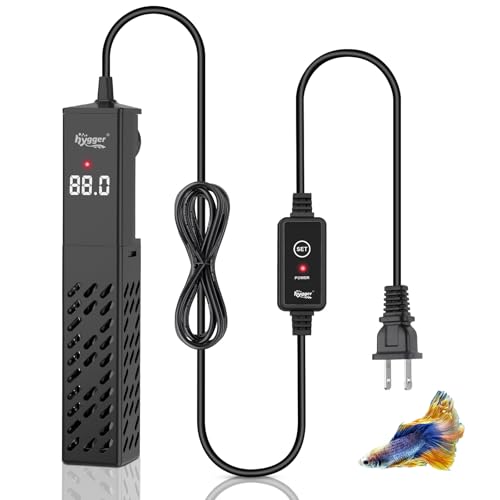
hygger 200W Ceramic Heater with Digital Display
Shatter-resistant ceramic with auto power-off and an external temperature controller.

hygger Small Betta Heater 10-100W with LED Display
Compact, accurate heater for nano tanks and bettas, sized 5 to 26 gallons.
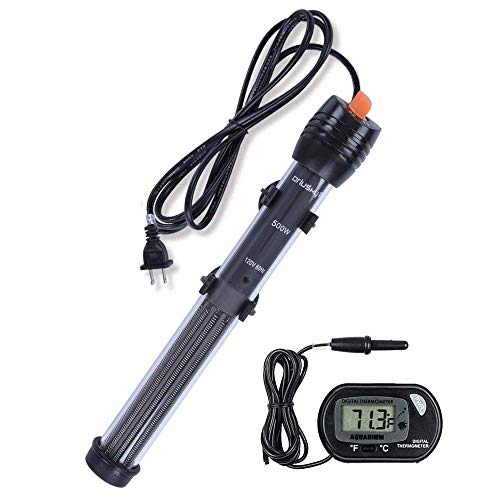
Orlushy Submersible Heater with Free Thermometer
A long-running budget favorite with a simple adjust knob and included thermometer.
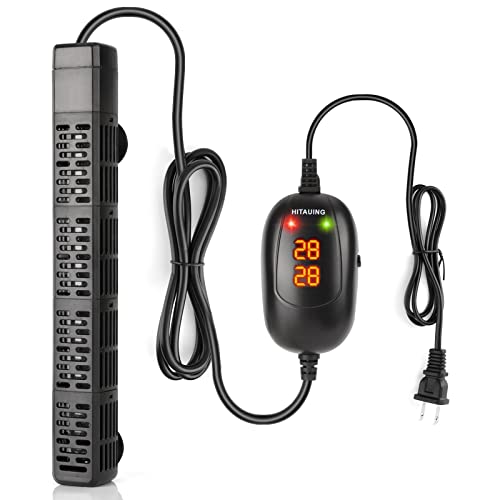
HiTauing 50-500W Heater with Auto Power-Off
Multiple wattages, over-temperature protection, and dry-run shutoff for safety.

AQUANEAT 200W Submersible Heater with Thermometer
Bare-bones, low-cost heater for 20 to 40 gallon freshwater or saltwater tanks.
Quick comparison
| Heater | Type | Best for | Approx. price |
|---|---|---|---|
| Fluval M 200W | Glass, slim profile | Most 30-50 gal tanks | $34.99 |
| hygger 200W ceramic | Ceramic, digital | Accuracy and durability | $25.99 |
| hygger small betta heater | Compact, LED display | Nano tanks and bettas | $16.99 |
| Orlushy submersible | Glass, adjust knob | Best overall value | $18.68 |
| HiTauing 50-500W | Auto shut-off | Safety-focused keepers | $32.99 |
| AQUANEAT 200W | Glass, basic | Budget 20-40 gal tanks | $11.99 |
Not sure how many watts you need? Our heater size calculator gives an exact wattage from your tank size, room temperature, and target temperature.
The picks in detail
Fluval M 200W: best overall heater
The Fluval M series earns its reputation with a slim, mirror-finish body that blends into the back of the tank and a thermostat that holds temperature tightly. The reflective surface helps it disappear visually, which aquascapers love, and the build quality is a clear step above bargain heaters. At 200 watts it suits tanks in the 30 to 50 gallon range. If you want a heater you can set and forget, with a track record of consistent accuracy, this is the one to start with. Add a standalone thermometer at the far end of the tank to verify even heating.
hygger 200W ceramic: best digital heater
The hygger ceramic heater pairs a shatter-resistant element with an external controller and a clear digital display, so you can dial in and read the exact target temperature without guesswork. Ceramic resists cracking far better than glass, which is reassuring in tanks with active fish or curious cichlids. Auto power-off and over-temperature protection guard against the stuck-on failures that ruin tanks. For keepers who want precise control and durability at a fair price, this is the standout digital option.
hygger small betta heater: best for nano tanks
Small tanks are tricky, because oversized heaters overshoot and cheap ones run cold. This compact hygger heater is built for the 5 to 26 gallon range, with selectable wattage and an LED display so you always know where the temperature sits. It is an excellent match for a heated, filtered betta tank, which should be 5 gallons or larger and never an unheated bowl. The small footprint hides easily behind plants or decor in a nano aquascape.
Orlushy submersible: best value
The Orlushy is a hobby staple for good reason. It is inexpensive, comes with a thermometer, and the simple adjust knob makes setting temperature straightforward. It is fully submersible and works in both freshwater and saltwater. You give up a digital display and premium materials, but for a second heater, a quarantine tank, or a budget build, it delivers reliable heat at a price that is hard to argue with. As always, verify the actual water temperature with a separate thermometer.
HiTauing 50-500W: safety pick
If safety features are your priority, the HiTauing line offers over-temperature protection plus automatic power-off when the heater is lifted out of water, available across a wide range of wattages from 50 to 500 watts. The auto shut-off is genuinely useful during water changes, when forgetting to unplug a running heater can crack the glass or burn out the element. Pick the wattage that matches your tank, and this becomes a dependable, protection-first choice for nervous keepers.
AQUANEAT 200W: budget pick
The AQUANEAT 200W strips heating down to the essentials at the lowest price in this guide. It is a basic submersible with an adjustable thermostat and an included thermometer, rated for 20 to 40 gallon tanks. There is no digital display and the materials are economy-grade, so treat it as a value or backup heater rather than a premium centerpiece. Paired with an independent thermometer and replaced on schedule, it keeps a tank warm without straining the budget.
How we chose
We did not run these heaters through our own tanks. This guide draws on published manufacturer specifications, accepted fishkeeping best practices, and the patterns that show up across large numbers of verified owner reviews. We focused on four factors: thermostat accuracy and consistency, safety features like over-temperature and dry-run protection, build durability, and appropriate wattage for the tank sizes each model targets.
Because a stuck-on heater is the most common way tanks overheat, we gave extra weight to models with auto shut-off and a credible reliability record in owner feedback. We also flagged the importance of an independent thermometer, since no built-in sensor should be trusted alone. Prices change often, so confirm the current cost on Amazon before purchasing, and size wattage to your real water volume rather than the printed tank size.
Sizing a heater to your tank
- Use 3-5 watts per gallon of real water volume as a starting point.
- Account for your room. A cold basement needs more watts than a warm living room.
- Consider splitting the load on tanks 40 gallons and up with two smaller heaters.
- Never trust one sensor. Add a standalone thermometer at the opposite end of the tank.
For an exact wattage, run the heater size calculator. If you are still planning your build, the aquarium volume calculator tells you the real water volume to size everything around.
Reviewed in depth
Two of the pieces here are covered in depth. The Eheim Jager heater review covers the best of the traditional glass heaters and the bi-metal failure that no glass heater escapes, and the Inkbird ITC-308S review covers the plug-in controller that cuts power when a heater sticks on, which is the cheapest insurance in the hobby.
Aquarium Setup & Maintenance Planner
Stocking planner, water-test log, cycling tracker, maintenance schedule, and more, in one printable planner that keeps your tank on track.
Frequently Asked Questions
What wattage aquarium heater do I need?
A good rule of thumb is 3 to 5 watts per gallon of real water volume. Use the higher end for cold rooms or a big difference between room and target temperature, and the lower end for warm, stable homes. A 40-gallon tank typically wants 150 to 200 watts. For an exact figure based on your room and target temperature, use our heater size calculator before you buy.
Should I use one heater or two?
On tanks of 40 gallons and up, many keepers split the load across two smaller heaters. Two units distribute heat more evenly and add a safety margin: if one fails off, the tank cools slowly, and if one sticks on, a smaller heater is less likely to cook the tank. For tanks under 30 gallons a single correctly sized heater is usually fine.
What temperature should my aquarium be?
Most tropical community fish thrive at 76 to 80 degrees Fahrenheit, bettas prefer 78 to 80, and goldfish like it cooler at 65 to 72. Reef and saltwater tanks generally run 76 to 78. Always confirm the ideal range for your specific species, and avoid swings of more than a couple of degrees per day, which stress fish and can trigger disease.
Are glass or ceramic aquarium heaters better?
Both work well. Glass heaters are inexpensive and widely available, while ceramic and titanium-style heaters resist shattering and tolerate being bumped or briefly exposed to air better. If you have large or boisterous fish, or you want extra durability, a shatter-resistant heater is worth the small premium. Whatever the material, look for accurate thermostats and auto shut-off protection.
Do I need a separate thermometer if my heater has a display?
Yes. A heater's built-in display reads the temperature at the heater, not necessarily across the whole tank, and built-in sensors can drift over time. Keep an inexpensive standalone thermometer at the opposite end of the tank as an independent check. If the two readings diverge, recalibrate or replace the heater before your fish pay the price.
How do I keep a heater from failing dangerously?
Buy a heater with over-temperature protection and auto power-off when exposed to air, then add a simple plug-in temperature controller as a backstop on valuable tanks. Always unplug the heater before water changes and let glass models equalize to air temperature before removing them. Replace heaters every few years, since thermostats wear out and stuck-on failures are the most common cause of overheated tanks.
Planning or running a tank?
Use our free calculators and guides to get every number right.
Aquarium Planner: $39