What Is RODI Water?
RODI water is reverse osmosis deionized water with near-zero TDS. Learn why reefers use it, what TDS means, and how to remineralize it for any tank.
RODI water is reverse osmosis deionized water, meaning tap water that has been filtered through an RO membrane and a deionization resin to remove nearly all dissolved minerals and contaminants, leaving water that reads close to zero on a TDS meter. In plain terms, it is the purest, blankest water you can make at home so you control exactly what goes into your tank.
RODI is the foundation of serious reef keeping and high-end planted tanks. Instead of trusting whatever your municipal supply contains, you start from near-pure water and add back precisely the salts or minerals your livestock need.
The two stages that make RODI water
An RODI unit cleans water in stages, each removing a different class of impurity.
- Sediment prefilter traps sand, rust, and grit that would clog later stages.
- Carbon block removes chlorine and organics, protecting the delicate RO membrane.
- RO membrane rejects the large majority of dissolved solids, including most minerals, nitrate, and heavy metals.
- DI resin polishes off the last few ppm of ions, pushing the final water down toward 0 TDS.
The reverse osmosis stage does most of the heavy lifting, and the deionization stage is the final polish that gets you to truly pure water. That two-step approach is what separates RODI from a plain RO unit.
Understanding TDS
TDS stands for total dissolved solids, a measure of all the dissolved minerals and ions in water, reported in parts per million (ppm). A cheap inline TDS meter is the simplest way to monitor an RODI system. Tap water often reads anywhere from 100 to 500 ppm or more, while finished RODI should read 0 ppm.
| TDS reading | What it tells you |
|---|---|
| 0 to 2 ppm | RODI is working perfectly, safe to use |
| 3 to 10 ppm | DI resin nearly exhausted, plan to replace it soon |
| 10 ppm and rising | Resin spent or RO membrane failing, replace and retest |
| 100 to 500+ ppm | Typical untreated tap water, not safe for sensitive tanks |
Watch your post-DI TDS, not just the tap reading. A steady climb means it is time for fresh filters before contaminants slip into your tank.
Why reefers swear by RODI water
Reef tanks live and die by water quality. Tap water commonly carries phosphate, silicate, nitrate, and copper, and even small amounts feed nuisance algae or stress corals and invertebrates. Starting from RODI removes all of those variables in one move.
- Algae control by denying nuisance algae the phosphate and silicate it craves.
- Consistency, since every batch of salt water you mix starts identical.
- Invertebrate safety, because copper from old pipes is removed.
- Predictable dosing, as you build the chemistry up from a known zero.
This is why RODI is treated as a basic tool in our saltwater aquarium for beginners guide, right alongside a protein skimmer and a quality salt mix.
You never use RODI water alone
Because RODI is stripped of minerals, it has almost no buffering and is not safe for fish on its own. You always add something back.
- Saltwater: mix RODI with a marine salt blend to your target salinity, usually 1.020 to 1.026 specific gravity for reef.
- Freshwater and planted: remineralize with a GH and KH product to rebuild hardness for your species.
To dial in how much salt your batch needs, run the numbers through our salt mix calculator. If you are tuning freshwater hardness instead, our explainer on GH and KH walks through what to add and why.
RODI Systems for Aquariums
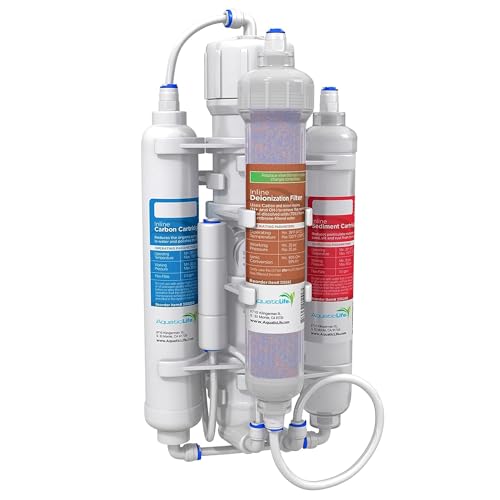
Aquatic Life RO Buddie 4-Stage RO/DI Water Filter System, 50 GPD
Compact starter RODI unit that removes most TDS for fish tanks.
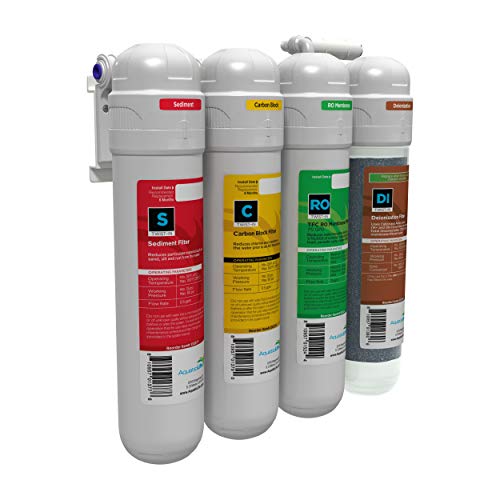
Aquatic Life Twist-in 4-Stage RO/DI Aquarium Filter System
Twist-in cartridge design that makes filter swaps fast and clean.

iSpring RCC1DP Tankless 5-Stage RO/DI System
Higher-output deionization system for larger or busier tanks.
Is RODI right for your tank?
Every reef and marine tank benefits from RODI, full stop. On the freshwater side it depends on your tap quality and your livestock. Hard tap water, soft-water species like discus and shrimp, or a high-tech planted setup all make RODI worthwhile, while hardy community fish in clean tap water may do fine with a good dechlorinator. To compare units by stage count and output, see our best RODI systems roundup.
Aquarium Setup & Maintenance Planner
Stocking planner, water-test log, cycling tracker, maintenance schedule, and more, in one printable planner that keeps your tank on track.
Frequently Asked Questions
What does RODI water mean?
RODI stands for reverse osmosis deionized water. It is tap water that has been pushed through a reverse osmosis membrane and then a deionization resin to strip out nearly all dissolved minerals, metals, and contaminants. The result is extremely pure water, usually reading close to zero on a TDS meter. Aquarists use it as a blank starting point so they control exactly what goes into the tank.
Why do reef keepers insist on RODI water?
Tap water carries phosphate, nitrate, silicate, copper, and chlorine that feed algae or harm sensitive corals and invertebrates. Starting with RODI removes those variables, so when you mix in a quality salt you know the exact chemistry going into your reef. It is one of the most effective ways to prevent stubborn algae outbreaks and to keep parameters consistent water change after water change.
What is a good TDS reading for RODI water?
You want your finished RODI water to read 0 ppm on a TDS meter, though anything from 0 to a few ppm is generally acceptable for most tanks. TDS, or total dissolved solids, measures the total mineral and ion content in the water. A rising TDS reading after the system is a warning that your DI resin is exhausted or your RO membrane is failing and needs attention.
Can I use RODI water straight in the tank?
No, pure RODI water has no minerals and almost no buffering, so it is not safe on its own for fish. For saltwater you mix it with a marine salt blend to the correct salinity. For freshwater and planted tanks you remineralize it with a GH and KH product to rebuild hardness. Using RODI lets you dial in exactly the hardness and salinity your species need rather than accepting whatever your tap delivers.
Is RODI water worth it for a freshwater tank?
It depends on your tap water and your livestock. If your tap is hard, full of chlorine, or unreliable, RODI gives you a clean, consistent base you remineralize to taste. It is especially valuable for soft-water species like many tetras, discus, and shrimp, or for high-tech planted tanks. For hardy community fish in good tap water, a quality dechlorinator may be all you need.
Planning or running a tank?
Use our free calculators and guides to get every number right.
Aquarium Planner: $39